Chile: Pullihue Composting Project (Sustainable Waste Management in Santiago)
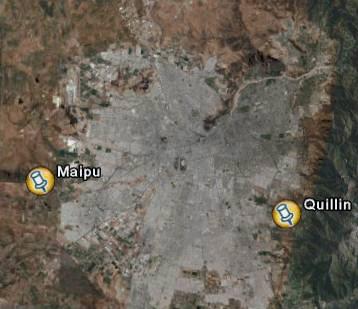 |
Santiago General Satellite View |
The objective of the Pullihue Composting Project (Project) is to avoid methane emissions from anaerobic decomposition of biomass – organic waste and biosolids (sludge) - through controlled aerobic decomposition. The aerated composting process will avoid methane emissions and will also result in compost as a product that can be utilized as a soil amendment in agriculture, horticulture, land rehabilitation, and landscaping. The Project will treat organic waste and non-toxic wastewater biosolids from Santiago. On average, it will divert approximately 266,000 tonnes of organic waste per year that otherwise would be disposed in sanitary landfills if the project was not constructed.
In contrast to the anaerobic decay of organic waste that occurs in the landfills, which results in methane generation among other gases, the composting project will contribute to mitigation of greenhouse gas emissions through aerobic decomposition of the organic waste, thus generating only non-fossil carbon dioxide (CO2) emissions, which are neutral to the environment.
Currently, almost all of Santiago’s Metropolitan Area waste material goes to 3 sanitary landfills. From a local environmental perspective, composting organic waste would reduce the pressure on sanitary landfills in Santiago, and therefore reduce future land requirements. In addition, the compost produced in the plant can be used as a soil conditioner for agricultural / horticultural purposes, to rehabilitate degraded lands, and/or to landscape gardens, parks and green spaces. Compost used in agricultural / horticultural applications will decrease the need for chemical fertilizer, which would reduce emissions from fertilizer manufacturing and nitrogen release from soil. No credit for these reductions were included in this assessment. Additionally, depending on the application, compost can be used as a substitute for the accumulated organic material of pre-mountainous forest environments (e.g. peat moss), which would aid in the conservation of this valuable ecosystem.
Currently there are no regulations in Chile requiring composting of organic waste or methane capture and flaring in landfills. Regulations only require that waste should be disposed at authorized sites and that landfill gas emissions should be controlled in order to avoid explosive hazards. To date, almost all waste generated in Santiago is disposed in sanitary landfills without any methane capture and flaring.
The Project will have two operational facilities, physically separated by about 27 kilometers (km) from each other. The first facility (Quilin Plant), that is expected to be fully operational in January 2007, will be located in the most eastern part of Santiago with capacity to process up to 50,000 tonnes of organic waste per year. The second facility (CEPROS Plant) will be located in the most western part of Santiago and with capacity to process up to 216,000 tonnes of organic waste per year. The CEPROS plant will be constructed in two phases, starting in 2007 with 108,000 tonnes per year capacity that will increase in January 2008 up to its full capacity (216,000 tonnes per year). Both plants represent a total capacity of 266,000 tonnes per year of organic waste, which is approximately 27% of the current total organic waste generated in Santiago. For the first 7 year crediting period (2007-2013), the project is expected to generate about 3.7 million tCO2e.
The CEPROS Plant will be located on 50 ha of property owned by the Universidad de Chile “Riconada de Maipú” within the Municipality of Maipú. The Quilin plant will be located on a 50 ha property of Agroindustrial Pullihue Ltda, within the municipality of Peñalolén.
|


