Madagascar: Andasibe-Mantadia Biodiversity Corridor
(BioCarbon Fund)
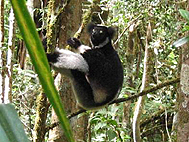 |
Indri Indri (largest surviving lemur in Madagascar, endangered) shown here in Analamazaotra (Photo: World Bank) |
The majority of the primary forests of Madagascar, which harbor large numbers of endemic species, has disappeared leaving only small remnants that are steadily being diminished by bushfires and logging. The predominant current uses of the land are for slash-and-burn cultivation and fuelwood production.
The project will cover a total of around 5,000 hectares. It aims first at restoring forest corridors linking fragmented habitats between the Analamazaotra Special Indri Lemur Reserve, the Maromizaha Private Forest and Mantadia National Park complex in east-central Madagascar. These parks are at the core of the remaining fragments of the Malagasy rainforest, are extremely rich in terms of biodiversity, and continue to be severely deforested. Second, the project will also establish sustainable forest and fruit gardens that will provide alternative livelihoods to local communities and a buffer around the corridor. In addition, the project aims at protecting an area of 80,000 ha of prime or degraded forest north of the corridor, so as to maintain continuity up to Zahamena National Park, located approximately 100km to the north. The overall goal is to enhance the viability of the livelihoods of both people and native biodiversity, while mitigating emissions of greenhouse gases. The additional income from the carbon sequestration is essential to the realization of this goal. More specifically, the project will establish natural forest corridors allowing viable biological connectivity among several currently isolated forests and protected areas and promote sustainable cultivation systems. The forest gardens are envisioned to comprise a significant proportion of local forest plants (primarily Ravensara aromatica, which can be planted so as to mimic local forests in both structure and function). The project falls under the umbrella of the Third Environment Program of the Republic of Madagascar, a $150M program to protect natural resources in the Island supported by major environmental NGOs, bilateral and multilateral donors, including the World Bank (IDA) and the Global Environmental Facility. This Program implements the National Environmental Action Plan of the Government.
The reforestation component is expected to sequester around 0.13 Mt CO2e by 2012 and around 0.31 Mt CO2e by 2017 (Kyoto compliant), while the avoided deforestation component could generate as much as 4 Mt CO2e by 2017 (non-Kyoto compliant). The project activities will significantly increase tree cover and reduce deforestation, turning a source of carbon dioxide emissions into a carbon sink. The gardens are self-supporting ecosystems that provide several critical ecosystem services and environmental benefits, including hydrological stabilization and watershed protection, and nutrient recycling and soil generation. These gardens would simultaneously provide social benefits through products of value to people, especially food and income, to support local livelihoods and a shift in land use practices from slash-and-burn agriculture (traditional production of tavy-rice) to more sustainable and stable practices. The project will monitor potential leakage stemming from the increased protection of the forest and change in land use. On the other hand, these changes will benefit local communities, which will, along with other arrangements, likely reduce the risk of non-permanence of the sequestration carried out by the project.
The project is developed and financed by ANGAP (www.parcs-madagascar.com), the financial and operational manager of Madagascar's system of protected areas, Conservation International (www.conservation.org), which will serve as intermediary, the Ministry of Environment, Water and Forests of Madagascar, and the World Bank.
THEMATIC INFORMATION
For more information on this project's thematic information (i.e., Biodiversity, Other Environmental Benefits and Risks, Socio-economic benefits and risks, Leakage, Risk of Non Permanence, and Additionality), please click here.
|


