Colombia: San Nicolás Agroforestry
(BioCarbon Fund)
|
Watershed area of two major hydroelectric dams, producing 30% of the nation's energy (Photo: MASBOSQUES) |
The San Nicolás Agroforestry project will actively promote and finance the establishment of agroforestry and silvopastoral systems, and of forest plantations on abandoned pastures. It will include training and capacity building of local stakeholders to ensure their sustainable management. The project seeks to generate financial resources to improve the livelihoods of small-scale landowners, sustain watershed management, conserve biodiversity, and to involve local communities, NGOs, the government and the private sector of the area. The project will be carried in the sub-region of the valleys of San Nicolás, which is made up of 9 municipalities in the eastern part of the Department of Antioquia. The sub-region is the hydrographic basin of the rivers Negro and Nare, which supplies water to several hydroelectric plants that are responsible for generating approximately 33% of the energy used in Colombia. The project will implement improved land management systems on 8,730 ha allocated by landowners wishing to participate. The project is formulating a Plan for Sustainable and Participatory Management that was drafted in the course of a consultation, lasting 20 months, with the communities of the region of San Nicolás.
The project is expected to sequester around 0.50 Mt CO2e by 2012 and around 0.99 Mt CO2e by 2017. The additional income brought by this sequestration will be key to realize the proposed activities. Their implementation will deliver a number of environmental services, including carbon storage and sequestration, watershed and soil protection, and conservation of biodiversity, notably through the creation of habitats and corridors for wildlife. In the plantation areas, the project will deliver increased revenue for landowners from growing produce. Other social benefits will come from direct and indirect employment from the project, increase in food safety in the region, and capacity building activities. These benefits and the longer sustainability and permanence of the project have been secured and increased through the extensive consultation carried out for the preparation of the Plan for Sustainable and Participatory Management that involved almost all local stakeholders, including most farmer communities, the municipalities, various NGOs, the church, two universities and various private sector organizations. This approach towards the capacity of economic development of the communities, and the minimization of potential socio-economic negative impacts has been a commitment during the phase of design of the project. Final decisions on land use were also made by the land owners (small farmers) through a participatory process. The strong implication of the communities should finally avoid any leakage outside the project boundaries.
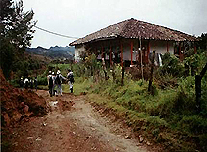 |
The project area is 90% privately owned, mostly small farmers (Photo: MASBOSQUES) |
CORNARE, a regional environment agency, will finance afforestation/reforestation activities. The Corporation for Sustainable Management of the Forests (MASBOSQUES) will contribute in-kind through the development of the project for qualified work. MASBOSQUES is a public-private partnership conformed by four types of members: Governmental (regional and local), business associations, local farmers, NGOs, and academic and research sector. Landowners will also contribute for non-qualified work. Project design has benefited from the assistance of the Swiss Federal Laboratories for Materials Testing and Research. Additional financing for the establishment and initial management of the project activities will come from the sale of the above listed environmental services.
THEMATIC INFORMATION
For more information on this project's thematic information (i.e., Biodiversity, Other Environmental Benefits and Risks, Socio-economic benefits and risks, Leakage, Risk of Non Permanence, and Additionality), please click here.
|


