China: Pearl River Watershed Management
(BioCarbon Fund)
UNFCCC Reference No.: 0547
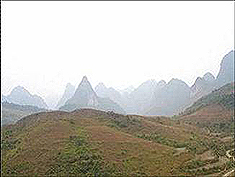 |
Project sites are barren mainly with scattered shrubs (Photo: Forestry Dept. of Guangxi Zhuang Autonomous Region) |
This project proposes to alleviate local poverty and reduce threats to local forests. 4,000 ha will be afforested in the Guangxi Zhuang Autonomous Region, which includes half of the Pearl River basin. The sites selected for planting are shrub land, grassland, and open tree land with tree cover below 20 percent so as to meet the Kyoto rule for China. 75% of the species planted will be native, including Pinus massoniana mixed, Liquidambar formosana, Cunninghamia lanceolata, Schima superba, Quercus griffithii and Quercus acutissima. Eucalyptus will make up the bulk of the exotics, though it has been grown in China for a century. The restoration of the forests along the middle and upper reaches of the Pearl River will help develop and demonstrate models for watershed management. The use of the carbon sequestered by a plantation as a "virtual" cash crop will generate income for local communities. As the first life-size LULUCF project in China, it will also test how afforestation activities can generate high-quality emission reductions in greenhouse gases that can be measured, monitored and certified.
Finally, the project will work within the confines of the larger Guangxi Integrated Forestry Development and Conservation Project (GIFDCP) umbrella (see more on this project), which addresses the closely inter-linked threats to Guangxi's natural forests, watersheds and biodiversity through an integrated approach to managing all these natural resources at the landscape level.
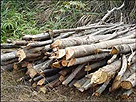 |
The project will provide ecosystem goods and services to local communities such as wood harvesting and resin collection (Photo: Forestry Dept. of Guangxi Zhuang Autonomous Region) |
The project is expected to sequester around 0.34 Mt CO2e by 2012 and around 0.46 Mt CO2e by 2017. It will connect fragments of forest land adjacent to nature reserves, thereby providing corridors and habitats for wildlife, and increasing biodiversity conservation in the reserves. Other environmental benefits include the reduction of soil erosion and the improvement of the regulation of hydrological flows, leading to reduced flooding and drought risks and providing incentives for people to invest in sustainable land use. The reforestation is additional in the project areas, since it is not economically feasible without the additional income from the carbon cash crop. With additional income and the carbon sales from managing the reforested lands as multiple-use plantations, the project can provide benefits to local farmers and communities that range from direct income supplements to broader social benefits. The project implementation itself will create about 5 million person-days of temporary employment and 40 long-term positions to local farmers, and about 5,000 households are expected to see their incomes increase through the sale of carbon and timber and non-timber forest products. The project design will identify any potential environmental or social risks and work to manage them appropriately. The local forestry agencies will in particular provide technical support and training to the local communities and individual households in designing, implementing and monitoring the project, and will monitor the environmental and social benefits including carbon sequestration. The implication of the communities will reduce the risk of non-permanence and any potential leakage.
The project will be financed by the Government of the Guangxi Zhuang Autonomous Region, farmer cooperatives, the Kangyuan and Fuyuan forest farms, the Luhuan Forestry Development Company, the World Bank through its loan to the GIFDCP, and a local agricultural bank. The forestry farms and companies are the private afforestation and timber production enterprises, which will implement and finance the project.
THEMATIC INFORMATION
For more information on this project's thematic information (i.e., Biodiversity, Other Environmental Benefits and Risks, Socio-economic benefits and risks, Leakage, Risk of Non Permanence, and Additionality), please click here.
|


