

|

Projects List
India: FaL-G Brick and Block: Micro Industrial Plants
(Community Development Carbon Fund)
UNFCCC Reference No.: 0707
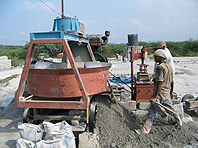 |
FaL-G brick production relies on the chemical reaction of fly ash, lime and gypsum under normal conditions and does not require burning. Hence, it fully replaces the use of coal and firewood (Photo: World Bank) |
Project Description:
The FaL-G project aims to promote fly ash bricks as an alternative to burnt clay brick with in the construction sector in India. Fly ash, the key ingredient of FaL-G technology, is a waste product from thermal power plants and is abundantly available in India. Fly ash is mixed with two other ingredients: lime, which is a byproduct of the acetylene industry and gypsum from chemical plants. This is proving to be a revolutionary invention that produces bricks without the sintering process meaning no energy is required in this process and consequently no greenhouse gases are emitted.
Many government departments, including the Central Public Works Department and state housing agencies, use FaL-G bricks. But even with more than 1,200 FaL-G brick making units operating throughout India, brick production from FaL-G operators is still a tiny fraction compared to that of clay brick producers 2 million FaL-G bricks a year versus hundreds of billions of clay bricks a year. With the help of carbon financing from CDCF, the project will bundle about 200 very small sector units and replace clay brocks with Fal-G brick production, with expected carbon emission reductions of 100,000 tons a year.
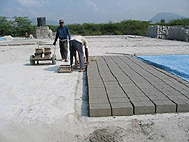 |
The project is additional due to technological barriers such as perceived risks of a product made of byproducts. Distribution of Fal-G technology in India is less than 1% in spite of 10 years of efforts (Photo: World Bank) |
Current Context:
Housing is one of the key issues in a rapidly growing and urbanizing India. Efforts are being made by both the public and private sectors to supply adequate shelter for the population. The challenge is to provide higher quality housing using construction materials that can be produced in a socially, environmentally and economically sustainable way. In India, clay bricks have been used for centuries and are the predominant construction material even today. Current demand is over 100 billion bricks a year. The suppliers range from industrialized modern manufacturers to old-fashioned small-scale operators. Workers in the clay brick industry in India-mostly in rural and semi-urban areas-are not well organized and live in poor conditions with little support to improve their lives.
The manufacture of clay bricks in the traditional way results in heavy environmental damage. Clay-brick manufacturing using typical kilns is also very energy intensive 200 tons of coal is used in sintering every one million bricks. The government of India has already committed to banning clay bricks in urban centers; however, economical technological solutions have to be found to achieve this goal.
Community Benefits Plan:
Traditional clay brick manufacture is seasonal work. The Fal-G technology is non-seasonal, so workers in the project's small communities will have year round work, with accident and health benefits, and better air quality.
Deliverables: heath and accident insurance; avoided denuding of top soil; better air quality
Timeframe: 2005-2013
Cost: US$42,000 per year (for insurance)
| Deliverables |
Description |
| Non-seasonal work |
Stable year round work producing Fal-G bricks, as opposed to traditional clay brick manufacture which cannot be carried out during rainy season |
| Insurance |
Project developer will provide heath and accident insurance to workers |
| Improved air quality |
The Fal-G process does not bake bricks in kilns thus avoiding air pollution |
| Avoided denuding of fertile soil |
Traditional clay brick manufacture denudes fertile topsoil in the manufacturing process-3500 tons is used for every million burnt clay bricks. The Fal-G brick process avoids this. |
Monitoring Plan:
Project sponsor: signs an agreement with each entrepreneur citing responsibility of entrepreneur on community benefits plan; to coordinate with the insurance company to identify covered workers; and periodically to check the status of the plan operation. Local entrepreneurs: carry out insurance arrangement and prepare monitoring of community benefits (other than insurance), explain to workers the features and benefits of the community benefits arrangements; monitor and report on the plan activity in accordance with agreement with the project sponsor; maintain and update the list of covered persons of insurance arrangement. Insurance company: processes the insurance plan; maintains insurance in accordance with agreed terms and conditions; and periodically reports the status of the coverage.
|
|
|
