Bolivia: Urban Wastewater Methane Gas Capture Project
(Community Development Carbon Fund)
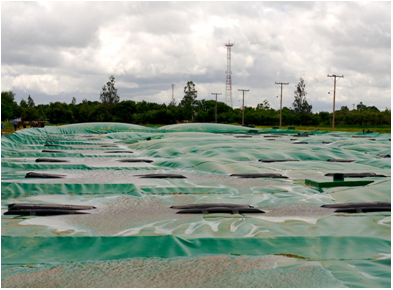 |
HDPE sheet covering anaerobic lagoon at SAGUAPAC facilities |
The recently approved World Bank IDA supported ‘Bolivia Urban Infrastructure Project’ aims to improve access to basic services for the urban poor in Bolivia’s major cities through targeted infrastructure investments. This project will cover 1.3 million people in Santa Cruz, and will target the poor areas. In order to reduce the effect of methane emissions on the global climate, this project will collect and flare the methane-rich biogas produced by these anaerobic lagoons, releasing only carbon dioxide, a much less powerful greenhouse gas.
In order to capture the gas, all primary anaerobic lagoons operated by SAGUAPAC (Project Entity) in Santa Cruz will be covered by a high-density polyethylene (HDPE) ‘geomembrane’ sheet, supported by a system of floats and supporting tubes. By raising the temperature and decreasing the available oxygen in the lagoons, this will also help to optimize the anaerobic digestion process and decrease retention time in the lagoons – contributing to an increase in the capacity of the treatment plants. The proposed project will purchase a total of 500,000 metric tons of CO2 equivalent (tCO2e) Verified Emissions Reductions (VERs) from the capture of methane gas at the SAGUAPAC wastewater treatment facilities in Santa Cruz.
Current context:
With a gross national income per capita of US$ 910, Bolivia remains the second poorest country in Latin America. A rapidly urbanizing society, combined with limited economic growth has contributed to Bolivia’s high urban poverty rate of about 52 percent. The city of Santa Cruz de la Sierra, a city of about 1.3 million inhabitants, lies in the semitropical eastern lowlands of Bolivia. Rapid population growth of above 6 percent in recent years, has left the city’s sanitation sector facing severe challenges to its sustainability, and the urgent need to address the threat posed by infiltration of raw sewage from areas not connected to the sewage network into Santa Cruz’s main aquifer – threatening irreversible damage to the city’s water supply.
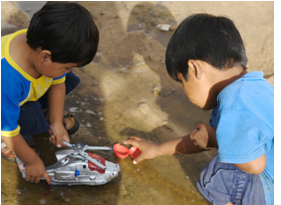 |
Children in Community Benefits Plan-targeted community plan in water on streets contaminated with raw sewage from household septic tanks |
Communty Benefits Plan:
On the basis of a socio-economic survey conducted by SAGUAPAC in the poor barrios surrounding the treatment plants, it was determined that neighborhood ‘UV-79A’ was amongst the poorest in the city, with over 33 percent of its inhabitants living in extreme poverty. Through a process of community consultation, lack of sanitation services was identified as one of the community’s primary basic needs. Currently, raw sewage from households and local industries not connected to the sewage networks infiltrates into the groundwater and mixes with storm water runoff. Besides generating unpleasant odors, this sewage is a source of infection, especially for children, who suffer from waterborne diseases such as dysentery, and diarrhea. By extending the sewage network to connect these households, the project is expected to generate a significant improvement in public health.
SAGUAPAC has estimated that the project will require an investment of US$ 350,000. SAGUAPAC will finance the project in its entirety, and upon completion will be reimbursed for US$ 200,000 by the CDCF (200,000 ktCO2e at US$ 1.00 per tonne premium).
Indicators of the Monitoring Plan
|
ID
|
Benefits
|
Indicator
|
Data Source and Methodology
|
Collection Responsibility
|
Measurement Unit
|
Baseline Value
|
|
1
|
Sewage system in community UV 79A
|
Number of households connected to the system
|
Report based on households registrations for connection
|
Independent verifier
(Information provided by SAGUAPAC and UV 79A)
|
No.#
|
0 household connected out of 600 households
|
|
2
|
Quality of service provided
|
% level of satisfaction
|
Annual community survey and report
|
Survey performed by SAGUAPAC among UV 79A inhabitants and verified by DOE
|
%
|
0 (There is no sewage system implemented)
|
|


