Mali: Senegal Plantation Project
(BioCarbon Fund)
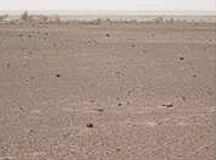 |
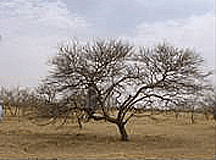
Degraded land in Mali |
The project will reforest about 10,000 ha of Acacia Senegal, a species endemic to the whole African Sahel, over a 6-year period (2006 – 2011). The project will build on a pilot project developed in the same type of environment in Niger, which also developed adapted technology. Out of the 10,000 ha, 7,000 ha will be developed on private land owned by (i) Déguessi Groupe (3,000 ha), a Malian private producer and importer/exporter of agricultural products, and (ii) the Malian Institut d'Economie Rurale (Malian Rural Economic Institute, IER) for 4,000 ha. The other 3,000 ha will be developed by farmers under partnership agreement on communal land. Déguessi Groupe will be the project developer and will implement the project through various sub-project agreements negotiated with IER and local communities. It will develop and manage cost-effective modern nurseries, contribute to farmers' training and assistance for planting trees, maintaining plantations, and gum harvesting. The project will also re-introduce agricultural activities through intercropping with groundnuts and cowpeas. The project will respond to the disappearance of Mali natural dry forests provoked by clearing way beyond regeneration capacity to meet the growing demand of firewood and cattle grazing. This deforestation has particularly affected gum-producing Acacia Senegal.
The project is expected to sequester 100,000 tons of CO2e by 2017 and 1.4 Mt by 2035. The project should also annually produce about 1,600 tons of gum as well as groundnut, cowpea and other crop production resulting from intercropping. Acacia Senegal is superbly adapted to harsh ecological conditions and produces several environmental benefits. Besides producing gum, it allows the rehabilitation of degraded areas that have become unfit for agriculture. Acacia's rooting system is very powerful, which makes it efficient for dune-fixing as well as wind and water erosion control. Its nitrogen-fixing ability improves soil fertility up to restoring agriculture. The restoration of a tree cover will also benefit local biodiversity. Hundreds of farming families are expected to receive social benefits from the project through additional revenues generated by Arabic gum, grains and forage, combined with Credit Emission Reductions (CERs). Their sale will be coordinated by Déguessi Groupe and will provide the necessary additional income to realize the project. Déguessi Groupe will purchase Arabic gum from participating farmers and IER, and redistribute the proceeds of CERs sale to them. The project will be implemented on desert land, which makes any leakage very unlikely, and the strong benefits brought to the population, along with other specific measures to fight fires, will significantly reduce the risk of non-permanence of the plantations.
Deguessi Groupe will be the pivot in the development of the project, with the continued technical support of the International Center for Research in Agro-forestry (ICRAF) and the International Crop Research Institute for Semi-Arid Tropics (ICRISAT). The project will also work in close collaboration with the Agricultural Diversification and Competitiveness Program (ADCP) financed by the World Bank. This program aims to foster better production conditions for agricultural goods in Mali, covering all steps in the production cycle from initial R&D; and the development of good practices, to commodity sales and access to domestic as well as international markets. It will support more particularly the setting up (over the first five years) of a unit dedicated to the implementation of the CDM operations plan, while financing part of the establishment of the community plantations.
The proposed project is highly replicable in the whole Sahelian belt of Sub-Saharan Africa. It is itself inspired from another similar project in Niger that is also included in the BioCF portfolio.
|