Albania: Assisted Natural Regeneration
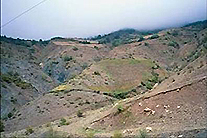 |
Badly degraded lands with little or no vegetative cover (Photo: MAF) |
The Assisted Natural Regeneration project aims to afforest and reforest highly degraded land and develop a multi-functional broadleaf and mixed broadleaf high forest of native species. It will include the following activities: (a) protection of areas for natural regeneration or re-growth by fencing; (b) supplemental planting at 200-500 seedlings per ha to enrich species diversity and to stabilize highly eroded areas; and (c) basic silvicultural works (vegetative cutting to promote growth such as coppicing, cleaning and thinning). The project will cover about 5729 ha spread over 24 communes and five regions, and would use the following species mix: two-thirds broadleaf and coniferous natives (oak, chestnut, maple, birch, walnut, pines) and one-third Robinia (from local seeds and planted with other species). The areas to be included in the project are all communal forest lands which usufruct rights are transferred to the communes. This project will be inserted in the framework of the Natural Resource Development Project (NRDP), and the objective of which are to establish or maintain sustainable, community-based natural resource management practices in hilly and mountainous lands that are prone to erosion and resource degradation.
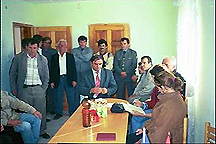 |
The most effective approach to date to address land degradation has been support to community forest and pasture associations (Photo: MAF) |
The assisted natural regeneration fits the afforestation/reforestation definition of the Marrakesh Accords and the additionality criterion since a deliberate effort is necessary to induce natural regeneration, prevented currently by the excessive grazing of goats. The activities included in the project are expected to sequester around 0.14 Mt CO2e by 2012 and around 0.25 Mt CO2e by 2017. The reforestation will help the environment by halting the ongoing degradation of forest lands, loss of vegetative cover and soil erosion, and will also positively impact on adjoining areas. It will also result in improved water quality, watershed capacity and lessening of siltation of watercourses and reservoirs. Such forests will provide much needed and valuable habitat for a wide range of native flora and fauna, and enrich and add to the natural biodiversity. At the social level, the project will provide an opportunity to bring critically needed sustainable revenue streams directly to poor rural communities in exchange of public good services, and can therefore have a significant impact on the populations' livelihoods. Over 80,000 people will benefit from this project through direct revenues from carbon sales, short and medium term employment, reduction of maintenance costs on irrigation and drainage infrastructure, reduction of the cost of water treatment, and reduction of flood risk. The developed forest will further serve as a sustainable source of firewood, poles, timber, fruits, fodder and other products for the local communities who currently have usufruct rights. Although the project areas were previously used as pastures, the risk of the project's achievements being reversed (non-permanence) is considered to be manageable. There are sufficient alternative grazing areas and pasture management will be improved. There will therefore be no need to exploit project areas. Measures will also be taken to avoid and monitor any potential leakage from outside the project areas. There is further support from local populations as in many cases families are already deriving income from the use of forest and pastures that had been seriously degraded lands prior rehabilitation investments by the now closed Albania Forestry Project.
The project is implemented and financed by the Government of Albania, through the Ministry of Agriculture and Food (MAF) and its Directorate General for Forests and Pastures (DGFP). Project preparation is supported by a Japanese PHRD Grant, and by direct contribution of beneficiaries.
THEMATIC INFORMATION
For more information on this project's thematic information (i.e., Biodiversity, Other Environmental Benefits and Risks, Socio-economic benefits and risks, Leakage, Risk of Non Permanence, and Additionality), please click here.
|


