Philippines: Watershed Rehabilitation
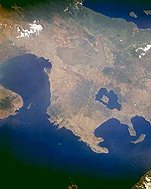 |
Satellite picture of the Laguna de Bay lake. Globally, this project will demonstrate how small scale CDM projects can be participatory and demand driven, using intermediaries. Locally, it will demonstrate how local governments can access carbon finance (Photo: NASA) |
This project will implement a set of small-scale community-based watershed rehabilitation sub-projects in the Laguna de Bay watershed, a watershed that contains 13% of the population of the Philippines. These projects will include three main activities: (1) streambank rehabilitation, that will increase the riparian forest cover of the rivers in the watershed; (2) reforestation in upland areas that will reforest denuded and grassland areas near the headwaters of key rivers; (3) agroforestry that will provide income for people in upland areas. Agroforestry will be directly undertaken by communities, and profits and revenues from carbon credits will also accrue to them. This project is part of the World Bank and Dutch-funded Laguna de Bay Institutional Strengthening and Community Participation Project (see more on this project), which supports land use and energy activities at the community level. Because of the high transaction costs associated with developing small-scale carbon finance activities, the project will use an umbrella approach in which the Laguna Lake Development (LLDA) authority will act as an intermediary, providing technical and financial support to the individual subprojects and aggregating them under one overall project.
As a small-scale afforestation/reforestation project, the maximum emission reduction is 8,000 t CO2 per year or 80,000 t CO2 over 10 years. The project is then expected to generate around 0.03 Mt CO2e by 2012 and around 0.05 Mt CO2e by 2017. The additional revenue from the carbon sequestration will nevertheless play a significant role for the subprojects realization. The reforestation resulting from the subprojects will provide several environmental benefits by addressing the heavy degradation of the Laguna de Bay, of which only 5 percent is currently covered by forest. It will more precisely reduce erosion in the watershed, which is contributing to a rapid rate of sedimentation in Laguna Lake, reduce land degradation, which has contributed to several severe landslides over the last 5 years, increase land and water conservation, and prevent flooding. Although limited in scale, the reforestation will also provide additional habitat for biodiversity. On the social side, in the short term the project will result in livelihood improvement (through agroforestry) and reduce localized erosion problems. Over the long term, several other social benefits will accrue from the reduced sedimentation in the watershed rivers and lake (e.g., improved fisheries and reduced costs of treating water for domestic use); reduced flooding and landslides (e.g., damage to assets and lost time from work); increased groundwater recharge (e.g., improved the sustainability of the water resource) and reduced topsoil erosion (e.g., improved agricultural production in the long term). The projects will be implemented on mostly unused lands with few competing use, which makes any leakage unlikely. Finally, the benefits brought to the population and the measures included in subprojects agreements will significantly reduce the risk of non-permanence of the plantations.
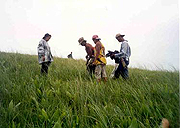 |
Reforestation in Upland Areas: The purpose of this activity will be to reforest upland areas in order to increase forest cover, stabilize upland areas, reduce erosion and enhance biodiversity habitat values (Photo: LLDA) |
The project is sponsored by the Laguna Lake Development Authority (LLDA). LLDA was established in 1966 as a planning, regulatory and development authority to protect and manage the ecological resources of the Laguna de Bay watershed. LLDA will be the carbon financing intermediary and technical advisor for the proponent local governments in the Laguna de Bay watershed. The Municipal Development Fund Office (MDFO) will be managing proceeds from a World Bank loan and allocating them, in a mix of loan and grants, to municipal governments. Municipal governments will in turn, through multi-stakeholder river councils, identify and implement the subprojects. The loan portion will be paid back to the MDFO by the municipal governments and each sub-project will assess its ability to pay that back. In general, when combining the components for sub-projects for a given microwatershed, it is expected that they will be income-generating and cover the loan.
THEMATIC INFORMATION
For more information on this project's thematic information (i.e., Biodiversity, Other Environmental Benefits and Risks, Socio-economic benefits and risks, Leakage, Risk of Non Permanence, and Additionality), please click here.
|


