Home
About Us
Carbon Funds and Facilities
>> Prototype Carbon Fund
>> The Netherlands CDM Facility
>> Community Development Carbon Fund
>> BioCarbon Fund
>> About
>> Participants T1
>> Participants T2
>> BioCFPlus
>> Projects T1
>> Projects T2
>> Document Library
>> Topic Areas
>> Useful LULUCF Resources
>> Italian Carbon Fund
>> The Netherlands European Carbon Facility
>> Danish Carbon Fund
>> Spanish Carbon Fund
>> Umbrella Carbon Facility
>> Forest Carbon Partnership Facility
>> Carbon Fund for Europe
For Project Developers
For Service Providers
Methodology
Projects
Capacity Building
News & Events
Document Library
Search
 
Site Tools
Carbon Finance Helpdesk
Glossary of Terms
Frequently Asked Questions
Related Links
My Page

Login
Username
Password


BioCFplus

The BioCFplus program provides project-specific support to BioCarbon Fund carbon sequestration projects in developing countries and economies in transition. The focus of this facility is on defraying project preparation costs. BioCFplus resources are also used to disseminate lessons learned and reach out to various constituents regarding the pioneering role of the BioCarbon Fund and to highlight the development benefits of carbon sequestration projects.

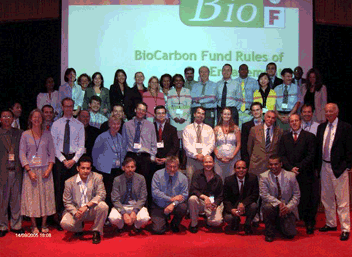
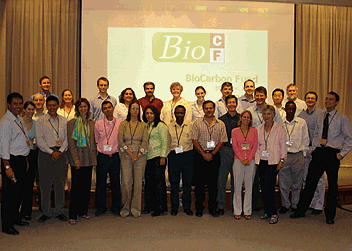
The first main product of BioCFplus was two three-day training seminars for BioCF project sponsors, which were held in July and September 2005, where the market, methodological and institutional aspects of BioCF transactions were discussed. See the presentations below.
September 12-14, 2005 Training Seminar
Additional Photos: 1, 2, 3, 4


Day 1
1. Carbon Finance Strategy of the World Bank
2. The Carbon Market including LULUCF
3. The BioCarbon Fund (Rationale and Overview)
4. The CDM/LULUCF Project Cycle
5. Baselines and Additionality
6. LULUCF Criteria (Forest definitions, tCERs vs. lCERs, etc.)
7. World Bank Legal Due Diligence and ERPA Structure
8. The World Bank's Safeguard Policies

Day 2
1. Baseline Methodologies for LULUCF: Overview
2. Field Monitoring for LULUCF Projects
3. Detailed Example of Baseline Methodology for LULUCF: ARNM0010, China
4. Monitoring Methodologies Submitted
5. Synthesis: What makes an acceptable methodology?

Day 3
1. BioCarbon Fund Rules of Engagement
2. Source Book for LULUCF Projects

July 11-13, 2005 Training Seminar
The first training seminar was held on July 11-13, 2005. It brought together several dozen people representing about half of the BioCF project proponents, as well as World Bank staff and experts from Winrock International and Joanneum Research.


Day 1
1. Carbon Finance Strategy of the World Bank
2. EU ETS Survey
3. The Carbon Market and State and Trends of the Carbon Market 2005
4. BioCarbon Fund Overview
5. CDM – LULUCF Project Cycle
6. Baselines and Additionality and Draft tool for the demonstration of additionality in
    A/R CDM projects
7. LULUCF Criteria
8. BioCarbon Fund Projects and World Bank Safeguards

Day 2
1. Baseline Methodologies for LULUCF: Overview and Simplified Baseline and Monitoring
    Methodologies for Selected A/R Small-Scale CDM Project Activity Categories
2. Field Monitoring for LULUCF Projects
3. The International Small Group and Tree Planting Program (TIST)
4. Methodologies for Moldova Soil Conservation project: ARNM0007
5. Comments on Monitoring Methodologies: Tanzania, Moldova, Brazil

Day 3
1. BioCarbon Fund Rules of Engagement
2. The choice of tCERs v. lCERs
3. Source Book for LULUCF Projects


Legal Disclaimer